Reframing the Emotional Asset
For High-Net-Worth Individuals (HNWIs) in Winnetka, Lake Forest, and Glencoe, the decision to Age in Place is rarely a calculation of economics. Instead, it is anchored in sentiment and the desire to remain in the family home that has served as a sanctuary for decades. While families often assume this emotional preference aligns with financial prudence, current North Shore market data reveals that this assumption is fundamentally outdated.
While the family home is often viewed as the ultimate asset, when overlaid with the medical infrastructure required to match the standards of a premier Life Plan Community, the home frequently transforms into a financial drain. For wealth managers and family offices, the data reveals a “cash flow cliff”: the total cost of ownership for a private residence necessitating 24/7 nursing oversight can consume between $300,000 and $900,000 annually in post-tax capital.
This report re-evaluates this choice through a solvency lens. We present a neutral, data-backed comparison of the financial exposure associated with the volatile private labor market versus the hedged financial structure of top-tier North Shore institutions like The Mather, Lake Forest Place, and Vi at The Glen.
The Labor Market Reality: Financial Impact of Clinical Necessity
The primary driver of insolvency vulnerability in the Aging in Place model is a fundamental misunderstanding of the medical nature and operational intensity of the labor required. For the ultra-wealthy, aging in place does not mean simply retaining household staff; it implies the replication of a high-acuity hospital-grade environment within a residential setting. This necessitates a shift from house managers to medical staff, exposing the estate to the volatile Illinois healthcare labor market.
The Agency Markup
To insulate the family trust from employment liability and ensure rigorous vetting, North Shore families rarely hire caregivers directly. Instead, they engage premium agencies. This risk mitigation incurs a steep premium: a surcharge that typically runs 40% to 100% above the direct wage paid to the caregiver.
The Financial Impact of Clinical Necessity (RNs)
If a client’s condition becomes medically complex, such as requiring ventilator support, wound care, or complex medication management, a Registered Nurse (RN) becomes a clinical necessity.
- The Data: While average wages vary, billing rates for elite agencies serving Winnetka and Lake Forest in 2025 range from $90 to $150 per hour.
- The Annualized Expenditure: A single 24-hour cycle of skilled nursing coverage typically ranges from $2,400 to $2,800. Annualized to include holiday premiums, this triggers a $900,000 to $1 million liquidity drain, almost entirely out of pocket.
The Financial Impact of Custodial Support (CNAs)
Even for standard “custodial” care, such as bathing, dressing, and mobility assistance, the financial floor remains high.
- The Data: Premium agencies in Highland Park and Lake Forest typically bill Certified Nursing Assistant (CNA) services between $33 and $43 per hour.
- The Annualized Expenditure: Even for this lower tier of support, these market rates establish a financial baseline of over $330,000 per year for 24/7 active care.
The “Live-In” Model vs. The “Split-Shift” Standard
The operational difference between Live-In care and 24/7 Split-Shift care represents a critical financial distinction. Unfortunately, this distinction is often obscured during the planning process, leading to significant unexpected variances. In financial planning, confusing these two models often leads to a gross underestimation of projected financial obligations.
The Live-In Economy Option and its Risks
The Live-In model is often presented as the affordable solution, typically averaging around $12,000 per month—roughly $400 per day. In this arrangement, one caregiver resides in the home for several days at a time.
- The “13-Hour” Pay Structure: The financial viability of this model relies on the agency’s ability to pay the caregiver for only 13 hours of active work per day (deducting 8 hours for sleep and 3 for meals). However, this math hinges on strict labor regulations: Under Illinois law, if a caregiver does not get at least five hours of uninterrupted sleep, the 13-hour deduction is voided, and the family trust becomes liable for the full 24-hour cycle.
- The Solvency Trap: This framework introduces a significant, unhedged volatility. The clinical triggers that breach the sleep window are not rare; they are common and often unpredictable. If a client’s condition involves “sundowning” (frequent nighttime waking) or incontinence, that five-hour sleep window is legally breached. Once this occurs, the engagement must convert to an hourly model where every single hour is billable. This acts as a tripwire in the estate plan, potentially causing the daily spend to triple overnight.
The Split-Shift Luxury Standard
For affluent families who require guaranteed alertness at all hours, the 24/7 Split Shift model is the only viable option. This involves multiple caregivers working separate shifts to ensure guaranteed alertness at all hours.
- The Rate and Commitment: The financial commitment is significant, but clinically necessary to ensure safety. With Illinois private care rates currently ranging from $38 to $45 per hour, the cost for 168 hours of coverage ranges from $6,384 to $7,560 per week.
- The Annualized Liability: This results in a recurring operating expense of $27,000 to $32,000 per month. Annualized, this creates a base operating outlay of $330,000 to $390,000 per year: a pure expense that offers no asset retention.
The Life Plan Community Hedge
In stark contrast to the unhedged recurring liability of home care, the North Shore’s luxury Life Plan Communities offer a financial structure that functions closer to a derivative hedge than a rental expense.
Entrance Fees as Asset Allocation
The substantial upfront investment of an Entrance Fee is often a psychological barrier. From a strictly financial perspective, it represents a reallocation of the balance sheet. Critically, this is not a pure consumption of capital. The resident moves capital from an illiquid asset (the family home) to a refundable deposit.
- The Mather (Evanston): Operating with a “Type A Life Care Contract”, Entrance Fees start at approximately $663,500 but can exceed $2 million for larger units. Crucially, these often carry a 90% refundability clause, meaning the vast majority of the capital is returned to the family portfolio.
- Vi at The Glen (Glenview): Similarly, this community offers a 90% return option. For luxury units (two bedrooms with a den) suitable for HNWIs, Entrance Fees range from $1.6 million to over $1.9 million.
The Cap: Hedging Future Liability
The true value of these communities lies in the Type A Life Care Contract, which provides an essential mechanism for strategic financial control by limiting future healthcare volatility.
- Predictability: If a resident transitions from Independent Living to Skilled Nursing, their monthly fee remains virtually unchanged, typically stabilizing between $6,000 and $12,000, depending on the unit size.
- The Variance: Compare this to the private estate model, where a similar medical transition triggers a jump from household expenses to a $30,000 per month staffing bill. The Life Plan Community caps this upside risk, protecting the estate from the volatility of the labor market.
The Insurance Blind Spot: The “Custodial Care” Exclusion
A critical misconception among affluent families is the belief that high-quality insurance, including Medicare and private health plans, will cover the expenses of 24/7 home nursing. This assumption is the primary cause of solvency shock for families who choose to Age in Place.
The Custodial Care Reality
Medicare and most private plans operate on a strict distinction between Skilled Care and Custodial Care.
- The Exclusion: Medicare explicitly excludes coverage for custodial care when it is the only care required. This includes the vast majority of long-term needs, including Activities of Daily Living (ADLs) such as bathing, dressing, eating, and supervision for cognitive decline.
- The Financial Impact: Even if a doctor orders 24/7 supervision for safety, such as for dementia care, if the care does not require a licensed medical professional to administer treatment, it is classified as custodial. This means the $330,000+ annual outlay for split-shift caregivers is 100% out-of-pocket.
The Skilled Nursing Limits
Even when treatment is classified as Skilled, such as post-stroke rehabilitation in a facility, Medicare functions as a short-term bridge rather than a long-term solution.
- The Cap: Coverage is fully paid only for the first 20 days. Days 21–100 require a daily copay, which exceeds $200 per day.
- The Cliff: After Day 100, Medicare coverage ceases entirely. Relying on this benefit for long-term aging is a fundamental solvency error.
Hidden Estate Drags: Taxes, CapEx, and Geography
Beyond the direct financial outlay for care, Aging in Place incurs significant operational and capital expenditures required to maintain a luxury North Shore home. These ongoing costs are often underestimated, creating a double drag on the property’s value.
The financial exposure of Aging in Place extends far beyond nursing costs. It is silently inflated by significant and recurring operational and capital investments essential to maintain a high-value North Shore estate. This combination of care expenses and estate drags creates a double-hit liability on the family’s wealth.
The Cook County Multiplier: A Silent Liquidity Drain
The North Shore is divided by a critical fiscal boundary, geographically split between the Cook County (Winnetka, Glencoe) and Lake County (Lake Forest) property tax regimes.
- The Cook County Drag: Winnetka and Glencoe residents are subject to the Cook County equalization factor, or “multiplier.” For the most recent tax year, this multiplier was set at 3.0163, a figure that effectively triples the assessed valuation of a property before the local tax rate is even applied. For a high-net-worth retiree, this regulatory detail acts as a silent, compounding drain on long-term cash flow.
- The Lake County Hedge: In contrast, Lake Forest residents typically benefit from an effective tax rate of approximately 1.87% to 1.95%. Over a decade, the compounding “tax drag” of remaining in a high-value Cook County residence can consume hundreds of thousands of dollars in liquidity that would otherwise be preserved by relocating to a Life Plan Community in Lake County.
Capital Expenditures: The Price of Accessibility
The multi-story architecture of the North Shore, dominated by Colonials and Tudors, is fundamentally incompatible with the mobility requirements of advanced age. As a result, retrofitting these homes is a non-negotiable capital expense.
- Residential Elevators: Installing a home elevator in an existing North Shore footprint is a complex construction project. Capital requirements typically range from $35,000 to over $80,000, varying based on the estate’s specific structural requirements.
- Luxury Accessible Bathrooms: Converting a primary bath to a curbless “wet room” that meets ADA standards while maintaining luxury finishes typically costs between $60,000 and $90,000.
- The Sunk Cost: Unlike a kitchen renovation, these accessibility modifications rarely add resale value to a historic home. They are effectively sunk costs: pure expenditures for safety.
The Verdict: Asset Preservation vs. Capital Destruction
This Solvency Stress Test reveals a counterintuitive reality. The substantial upfront investment in a Life Plan Community, though often viewed as an expense, is more accurately a strategic maneuver for capital preservation. Conversely, the low-cost default of staying home often manifests as a significant depletion of capital. While the emotional pull of the family home is undeniable, the financial reality is that it often becomes a financial burden rather than an asset.
The 10-Year Projection
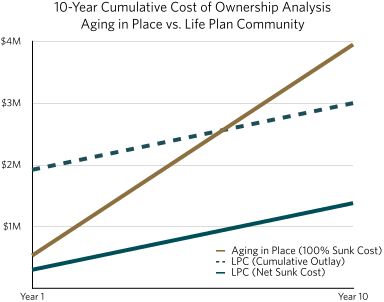
This data contrasts the unhedged, 100% sunk cost of Aging in Place against the financial structure of a Life Plan Community. Note that while the Community requires a higher initial cash outlay, the refundability of the entrance fee results in a significantly lower net sunk cost, preserving approximately $2.57 million in estate value by Year 10.
- Aging in Place: A decade of private 24/7 care ($3.3M), combined with high property taxes ($500k) and necessary accessibility renovations ($150k), results in a Total Sunk Cost approaching $4 million. This capital is permanently consumed, offering no residual asset value.
- Life Plan Community: While the upfront outlay is significant ($600k to $2M), the 90% refundability clause preserves the principal. The net cost of living is stabilized, and the estate is hedged against the volatile inflation of the private labor market.
Executive Summary: Common Solvency Questions
No. Medicare classifies 24-hour supervision and assistance with daily activities such as bathing or dressing as custodial care, which is explicitly excluded from coverage. Families must pay for this out-of-pocket or utilize long-term care insurance.
While remaining at home avoids an upfront entrance fee, the unhedged cost of 24/7 private care in Chicago’s North Shore often exceeds $330,000 annually. Over a 10-year period, a Life Plan Community typically preserves more estate value due to capped costs and refundable entrance fees.
A Live-In caregiver sleeps in the home and is legally entitled to eight hours of sleep, with at least five hours uninterrupted. Split-Shift care involves rotation of caregivers on active duty to ensure safety around the clock. For complex medical needs, Split-Shift is the clinical standard, though it costs significantly more.
Recommendation
From a strictly financial perspective, relocating to a Life Plan Community effectively hedges the portfolio against volatility. Clients electing to Age in Place must immediately budget for an annual liquidity requirement of at least $350,000 (which accounts for the base care expense plus property taxes and maintenance) and recognize that this expenditure purchases no asset value, but is a pure operating expense.
Audit Your Care Plan for Solvency
The Solvency Stress Test is a financial equation, but its variables are medical. A spreadsheet cannot predict the sudden fall, the clinical triggers of dementia, or the emotional toll of a crisis that requires 24/7 nursing. Without accurate clinical data, even the best financial plan is merely speculation.
As your private health advisor, Avoa Health provides the care architecture your Wealth Advisor needs to protect your estate. We function as your neutral health strategist, translating complex medical needs into the clear, defensible data required by your wealth manager and estate planner.
Don’t build your family’s financial future on clinical assumptions. Contact Avoa Health for a confidential Clinical Feasibility Audit. We will work with your wealth advisor to validate the true long-term financial implications of your aging preferences, ensuring your estate—and your peace of mind—are protected.